Saturday, September 29, 2007

Healthy

It is possible to discover
a new depth of healing and freedom…
to experience the love of God…
to find intimacy with him. – ChangePoint Ministries

“I am the Way, the Truth and the Life…” – Jesus

For many years my home church in Auburn, WA has attracted and served people who were coming out of problems with addiction and abuse. Many recovering alcoholics have found it a safe and refreshing community. We’re pretty ‘into’ things like healing prayer, using spiritual gifts, etc. – at least, for Presbyterians! (My friends in more deeply charismatic circles might say it’s pretty tame stuff and we still have a long way to go!)

It’s been 13 years now since I moved away, and there’s been a lot of turnover. The entire church staff has changed, and most of the people in the church now come from a different town and culture – Enumclaw, not Auburn (the church is in the middle). But I think many of the best things about the church have only gotten better.

A few years back a ministry of personal healing and transformation developed through the church, eventually spinning off into a new organization, ChangePoint. For the last month or so I’ve been carrying around their August newsletter, chewing on one of the articles, by a woman named Yvonne. Here’s part of it:

Do you know anybody you would consider healthy? …is health important to God? What does being healthy mean? Are we healthy, and if so, what is the evidence?

We learn in the Old Testament that God required that sacrifices be without defect. In the New Testament Jesus was offered as a sacrifice for us – a lamb without blemish or defect 1 Peter 1:19). In Romans 12 we are told to offer ourselves as living sacrifices. Psalm 103:3 teaches us our source of health is Jesus who “…forgives all my sins and heals all my diseases.” Our health is a result of Jesus’ sacrifice; our journey as believers is one of learning to live in that reality.

Most definitions of being healthy contain the idea of it being a process of continuous adjustments to the demands of living. A healthy person is able to handle normal levels of stress and to recover from difficult situations. Physical, spiritual, or emotional perfections is not required for us to be considered healthy. Someone who is healthy is someone who is able to change with life’s circumstances. People who walk closely with God know this kind of healthy. They know that God is the source of their ability to adjust.

…Physical health cannot be maintained without a healthy immune system. The same is true for spiritual health. …It is only in intimate ongoing relationship with God that we are protected from the onslaught of the enemy’s attacks against our defenses. ..It requires a deep understanding of who God is, who we are in Christ, and a humbling knowledge of what we’ve been saved from. …When God is at work in a life there will be evidence of physical, spiritual, and emotional transformation. The fruit of healing is revealed as the fruit of the Spirit changes how we look, what we say, and what we do.

I had never really though about spiritual or emotional health in the same terms as physical health – that it could be ‘measured’ by one’s ability to change and respond to change, with a healthy immune system that can resist and recover from attacks. But it rings true, doesn’t it? Not that we want to set up some ideal of the Christian life as being one that doesn’t include sickness or suffering, or that walking with God means not having these things. But so many of our troubles are of our own making – or our own magnifying, at least.

So thankful for the grace of God in all this. He doesn’t say, “You idiot! Why don’t you get up and walk?!” He is gentle, and he is spirit, able to work in our inner being to empower, transform, and renew.

Another friend of mine shared in a recent sermon that he’s been struggling emotionally for the last 6-12 months. He lost some important people in his life – seemed like one right after the other. And he was expecting himself to just get over it, after all, he’s a pastor, shouldn’t he stop moping around? But he couldn’t seem to get past it, couldn’t get over it.

When it was time to take a vacation he went a few days early by himself. He was still miserable – exhausted, but unable to sleep. He went to church, and the preaching was bad and he didn’t like the music and the people were nice but they didn’t really mean it, he could tell. Oh, he knew it was him, not the church – he was in bad shape. It was like he was at the bottom of the well and nobody’s help, or love, could reach him.

One day he was standing on the end of the cliff and tempted to jump off. “You could be with your friends… you wouldn’t hurt anymore,” said the voices. "Brad, do not do this thing," said other voices. He cried out to God. And next thing he knew he was away from the cliff. And overcome by a great weariness. He stumbled his way back to where he was staying, laid down on the bed fully clothed, and slept for the next 18 hours. When he woke, he was no longer at the bottom of the well.

How does God respond to a suffering, confused, or rebellious heart? He notices, he sees it. He doesn’t ignore it. He hears its cries. He listens. And he answers.

Thursday, September 27, 2007

Closet

I still have that house fantasy about meriting a master bedroom someday - with the big, walk-in closet and maybe a queen-sized bed!

Meanwhile, though, I'm quite pleased with a recent solution to my closet problem. I put a ban on buying any new clothes until I found a better way to organize and take care of the ones that I had.

Introducing: shirt hangers. I'd long been a fan of multiple-skirt hangers, those that can hold five or six skirts, keeping them visible and relatively unwrinkled without taking up a lot of space. I got something like that for organizing my scarves. But now I have a similar, handy system for my T-shirts. Did you know they made such a thing?

Much better. Now I won't forget what I already have - a good safeguard against over-shopping. No, it is clear to me just how many reddish knit shirts I've acquired... (a rather large collection) as well as easier to figure out which skirts or whatever will go with them.

Now the shelf space I have is primarily filled with things that don't wrinkle, and all but the pants and sweaters are organized in actual bins (a step up from my decade-old cardboard boxes) neatly lining those shelves. Ah....

I'm no Martha Stewart, but I wish I'd tried this long ago!

Wednesday, September 26, 2007

Living Hope

Praise to God for a Living Hope

Praise be to the God and Father of our Lord Jesus Christ!

In his great mercy he has given us new birth into a living hope through the resurrection of Jesus Christ from the dead, and into an inheritance that can never perish, spoil or fade—kept in heaven for you, who through faith are shielded by God's power until the coming of the salvation that is ready to be revealed in the last time.

In this you greatly rejoice, though now for a little while you may have had to suffer grief in all kinds of trials.

These have come so that your faith—of greater worth than gold, which perishes even though refined by fire—may be proved genuine and may result in praise, glory and honor when Jesus Christ is revealed.

Though you have not seen him, you love him; and even though you do not see him now, you believe in him...

(1 Peter 1:3-8)

Drawing by Megan Noel

Monday, September 24, 2007

More on a Theology of Listening

Two things I found when I Googled 'Theology of Listening.' (Highlighting mine...)

Source: Article by Lloyd Steffan

…Resisting the call of the other to come out of oneself and make oneself available to the other, which is the temptation of self-centered-ness, can itself be countered by performing various activities of openness, none of which is more important than listening.

The ability to listen depends not in the first place on any particular skill or technique, but on a fundamental respect for one’s partner in conversation. Listening is thus a moral act. Listening ...disrupt[s] our comfortable self-images and threatening to undo our everyday experience of ourselves (and others) as familiar and basically unified personalities. Not listening becomes a way of securing ourselves from encounter with the mystery of otherness. Listening exposes us to our own desires not to want to share of ourselves. Listeners are required not only to welcome the strangeness of the other but to risk self-disclosure in the act of listening, for the listener must at some point recognize and then expose to the other his or her own strangeness -- and not only to the other but to one’s own self.

As a college teacher, I often hear colleagues at my own school and at other institutions bemoaning their students' poor communication skills, especially their writing skills. Poor writing, however, is a symptom of a deeper problem: students also have difficulty reading. Many students do not love reading or working at reading and therefore have not learned how to engage a text. Many do not listen to those who would speak to them through written words, which is to say they do not understand that they must approach a text, even one they find disagreeable, with respect and the openness of humility. The reading problem, then, is itself a symptom of a problem with listening. Many students do not know how to listen, even to themselves.

After talking about this deeper problem for a long time, my colleague ... and I developed an experimental course called The Listening Point. ...It used no books. The premise of the course was that the students would be the texts. They were required to engage one another in conversation, to develop listening skills, and to learn to think through their own and one another’s ideas…

Each week, students were given listening assignments, usually requiring meetings of three students. They would meet outside class to discuss an issue: two people would talk while the third would listen and then report to the class what happened in the discussion. Students were continually called on to summarize the main points of someone else’s remarks, to ask critical questions or seek clarifications about ideas they did not understand.

…Several students complained that they got headaches from having to pay attention for the two-hour Monday night class; several others told us that they could not seem to relax after class, and that they kept conversations going into the wee hours.

The final exam was to participate in a conversation about a question previously discussed in the course, selected at random. Students were evaluated not only on how well they listened to each other but on how much they helped the other person clarify and articulate his or her positions. That is, they were finally evaluated on how well they helped another person listen to herself.

This course was eye-opening. Students got to know one another and professors got to know students in new ways. Most students found out that they really were interesting texts; others confronted some serious personal issues, turning the discussions in a therapeutic direction -- an allowable move since clear thinking and self-confrontation are essential to both philosophy and therapy. But what was most important was the development of listening skills.

The first stage of listening required that students simply attend to the other person and hear what the person is saying. That required students to eliminate distractions, to be present to the other person, and to stop interfering with communication by anticipating one’s own response before the other person had even finished speaking. Second, students learned to evaluate critically what they heard. Here the test was to be able to repeat what had been said, to summarize the other person’s position to the other person’s satisfaction, then to seek clarification and offer critical response, usually in the direction of seeing how adequately the speaker’s argument could be defended. Imagination was required at this stage of listening, for students had to consider implications and imagine possible problems that might arise from the other person’s thought; they also had to attune themselves to the other and actually try to see things from the other person’s point of view. The third stage, which we rarely saw but occasionally glimpsed, occurred when persons presented themselves before the other and revealed themselves in a true engagement with the other, sharing not only words but gestures and intentions, and being understood so well that another student might actually volunteer to articulate a position or idea better than did the person offering it -- yet without necessarily agreeing with it.

Students seemed most amazed by how much they disagreed -- something they were not finding out from their other classes or even from their social life. They found that their disagreements were very interesting and not cause for alarm or embarrassment or increased defensiveness.

Also found this: Bonhoeffer on The Ministry of Listening

"Brotherly pastoral care is essentially distinguished from preaching by the fact that, added to to the task of speaking the Word, there is the obligation of listening. There is a kind of listening with half an ear that presumes already to know what the other person has to say. It is an impatient, inattentive listening, that despises the brother and is only waiting for a chance to speak and thus get rid of the other person. This is no fulfillment of our obligation, and it is certain that here to our attitude toward our brother only reflects our relationship to God. It is little wonder that we are no longer capable of the greatest service of listening that God has committed to us, that of hearing our brother's confession, if we refuse to give ear to our brother on lesser subjects." - Dietrich Bonhoeffer, Life Together, p.98.

Wednesday, September 19, 2007

What Would Your Perfect Day Be?

(I am still interested in your thoughts on Sunday's post on listening. Please feel free to email me or comment. I'll come back to the topic as well.)

Today’s “Work-at-Home Wednesday” actually had me out of the house more than in it – worked at two different coffee places, both with free wireless access, and topped it off at our nearby bookstore the Tattered Cover where author Robert Fulgham gave a short talk before signing copies of his recently published book.

It so happens that the book was first published months ago, in the Czech Republic, but has just come out in the U.S. On one visit to Prague, Fulgham said his editor there gave him three folded scraps of paper and asked him to pick one; what it said would determine their entertainment for the day. “Go to the zoo” it read. (So did the other two scraps, he later found.) There had recently been terrible flooding in the city and the city zoo had been badly damaged, so many of the cages were empty, the animals gone. “That’s OK,” said the editor, “we will imagine the animals.”

That’s how it came to be that the Prague zoo was where Robert Fulgham saw his first saber-toothed tiger – his first unicorn – his first dragon – and his first pterodactyl…

* * *

Yesterday was the first meeting of the year for my church’s women’s Bible study. I have a hard time appreciating women-only events; they often seem to bring out or concentrate feminine traits that I don’t like to see concentrated! Well, this time I tried to put aside my preferences, and prayed hard: prayed to be able to enjoy these ‘ladies’ for their own sake – to believe they each had a story – and to listen. The group organizers had each person share what her perfect day would be. I tried to pay attention to and remember their stories, instead of letting my mind dwell on what I was going to say and how I was going to say it. The mother with young children longed for a spotless house and someone to make dinner; the empty nester just wanted her children back, no matter how loud or messy. One woman wanted to shop with her girlfriends; another to sit on the porch of the country cabin drinking coffee with her family. Some wanted a day with no alarm clock; others would take the early-morning walk on the beach with their husbands.

Well, it is a question I’ve been pondering lately. My pastor from Washington called me not long ago to remind me that if there was anything I’d always wanted to do, that they would stand with me, that as far as they were concerned I pretty much had a blank check… I suppose that’s true. My supporters are just so – supportive! I was touched just to realize that someone would WANT me to have a perfect day. But didn’t know how to answer. What DO I want - that I could have - if I could name it? What would be the kind of day (or week, or month) that would really refresh and renew me? Nothing really rose to the surface as I thought about it. I’m still thinking. If a fairy godmother or the Make-a-Wish Foundation or just a coalition of people who loved you offered to make a dream of yours come true, what would you choose?

When I told my co-worker Keith about this he mentioned that when Heather Mercer and Dayna Curry got out of prison in Afghanistan, their home church sent them and a couple friends on an all-expenses-paid vacation to someplace fun and comfortable. That it seemed like a weird thing to them, and to some others, but it was somehow the right thing to do.

I don’t know if I have any friends of the kind I could say “hey, let’s go to Hawaii!” to. Maybe. I suppose if I put it that way, if I said, “Hey, want to come to Hawaii, for free?” I would have no shortage of takers. But who would I really want for my companions on the vacation of a lifetime, if I could choose them? I’m not sure.

Would a perfect day involve travel, vacation? I don’t tend to enjoy those things as much as some people do. When I met with a financial planner last year she tried to see if I was interested in seeing the world, but I told her what I do – and got her to see that I’d probably be happier spending my retirement in a nice little house where I can write, and a volunteer job somewhere.

The trip to the Balkans and Greece was quite good, though, actually; I haven’t written much about it. But the time included a lot of things I really like. And S. and I are making a trip to Ohio for another friend’s wedding, in about 10 days, which I’m looking forward to as well.

Next month my mother and sister are coming to Denver to drive down to New Mexico. Meg’s wanted for years to visit Taos and Santa Fe, so we’re going to do it. When we were talking about it Mom said she thinks this is the first trip the three of us have taken together since – the 1980s? “We’ll make sure to do something like this EVERY 20 years!” she joked. I don’t know how the three of us will get along, spending, what is it, five whole days together, but I’m hopeful we can get to know each other on a new level and establish some good patterns rather than just playing out old struggles. I had that many days with my dad and stepmother a year or two ago, also setting a record for family togetherness. It had always been three, four days max, and often just dinner, overnight, or for a weekend.

I tend to think having a good time is more a decision than a set of circumstances – and believe I should be able to have something close to a perfect day just by enjoying the days I have – like Robert Fulgham. I’m not naturally playful, but more serious and moody by nature. The loneliness problem can be pretty fierce. But I do find the world an intriguing place, and its inhabitants quite fascinating! So it’s not that hard to make my own fun or find it in strange but everyday places.

I’m also not a methodical person, really: not a creature of habit. I don’t do things the same way twice. So that also made it hard to describe my ideal day. It should have some element of surprise, discovery, newness. So who could describe it, until after it happens? Might be easier to drop the idealism and say, what would be a good day – or week – or month – and not the ‘best’ one. I told the women’s group that, and mentioned my recent reflections that happiness seems to require each day having some balance of purposefulness and meaningless – that a steady diet or even just a whole week of just one or just the other – is too much for me.

Little things like Work-at-Home Wednesday and the chance to sit and drink coffee and listen to stories at the Tattered Cover tonight do a lot for me. And I’ve also (strangely) become the party-organizer at the office. Wouldn’t you like to join us for this week’s event, with its appropriately corny name, ‘Flapjack Friday’?! Yes, breakfast together before staff meeting. I knew my co-worker Matt saw pancake-making as something of a specialty, and sure enough when I suggested it he was quick to volunteer!

Sunday, September 16, 2007

Toward a Theology of Listening

Start here, but for more on this topic, see also:

More on a Theology of Listening (9/24/07)
Listing and Listening (12/29/07)
Diffusing Tension with Respect (11/27/07)
Story Questions (4/2/08)
PowerPoint: The Ministry of Listening (6/18/08)

There’s a Bible study I’ve pulled out and used in so many contexts that I finally realized it must reflect or have come to shape my core values and become a recurring theme in my life. It’s one of the things I believe most deeply and see as most practical and relevant to life as we know it. The topic: remembering what God has done. The practice of reflection on what God has done is one of the best ways of developing two of the things we may need the most: gratitude and hope.

Knowing how good it is for us to have these things, and to see clearly, God and his prophets repeatedly exhort the people: Remember! Talk about what you’ve seen and heard, tell those stories, write them down, sing about them, tell them to your own hearts, tell them to your children, tell them to the people, tell them to the nations... don't forget.

A few weeks ago I started thinking about another one of those core values, those themes, that I want to shape my life and consistently pass on to others: listening. A high value for listening to people is a big part of my job, of course – perhaps why my job even exists. I teach people how to listen. I create environments where people can listen. I send them out to talk to people who need to be heard. I facilitate discussions, I look for consensus, I listen for problems and fears and hopes and expectations. In my recent trip to the Balkans, the whole reason I went was to listen to the team and help them articulate what they’d heard, to talk about the lives of those they’d been listening to as well as how the process affected their own lives and what they thought it meant.

Even so, I am not sure that listening is really something I practice faithfully or well.

There’s nothing I love as much as a good three- or four-way dialogue. So, I find it really irritating to be around people who prefer making speeches =over= starting conversations, expressing themselves over listening to others. As I lose my temper I find myself thinking of cutting things I could say to them (if I could get a word in edgewise...)

But, ah, yes, often I am one of the talkers! All my imagined retorts are symptomatic of a tendency to dismiss other people with whom I don’t agree (or, let's be honest, don't like. I'm fine with disagreeing!). Hijacking the conversation away from the monologist seems to be the only way I know to stop what they are doing, and I seldom do it gracefully. I seem to be guilty of the same thing I accuse them of, and I use the time and energy when I should be listening cooking up my righteous indignation and strategizing my response. (Take a look at James 1:19-27.)

Isn’t it amazing that God is a listener? Surely that's a key point for our theology of listening. If anyone knows best, and doesn’t need to listen, it would be God. Now and then there are signs that he has heard enough already, that he’s disgusted and inclined to turn away, but what we mostly see is “The Lord, the Lord, gracious and compassionate, slow to anger, and rich in love.” He says: I’m here, I’m listening; I love to listen. If God is willing to humble himself to listen, well, it says something for us as well.

What does Jesus teach us about listening? I’ve started a leisurely exploration of this. I haven’t gotten terribly far. Here’s where I started – with this kind of odd thing Jesus used to say. When I checked it out, I realize it must have been something he said a LOT. I parceled out references and had a group of people read these out loud recently, and they must have thought I was crazy because the repetition was so exact. The scriptures record the same phrase from Jesus 14 times:

Revelation 2:7 – He who has an ear, let him hear what the Spirit says to the churches.

Revelation 2:11 – He who has an ear, let him hear what the Spirit says to the churches.

Revelation 2:17 – He who has an ear, let him hear what the Spirit says to the churches.

Revelation 2:29 – He who has an ear, let him hear what the Spirit says to the churches.

Revelation 3:6 – He who has an ear, let him hear what the Spirit says to the churches.

Revelation 3:13 – He who has an ear, let him hear what the Spirit says to the churches.

Revelation 3:22 – He who has an ear, let him hear what the Spirit says to the churches.

Revelation 13:9 – He who has an ear, let him hear.

Matthew 11:15 – He who has ears, let him hear.

Matthew 13:9 – He who has ears, let him hear.

Matthew 13:43 – He who has ears, let him hear.

Mark 4:9 – Then Jesus said, "He who has ears to hear, let him hear."

Luke 8:8 – When he said this, he called out, "He who has ears to hear, let him hear."

Luke 14:35 – "He who has ears to hear, let him hear."

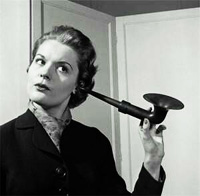
Well, to whom did God give an ear? Anybody have two of them? So, who has the capacity, and perhaps the responsibility, to be a person who listens? I know this is a figure of speech, but it works because the whole point of having ears is to listen, and listening means perceiving, getting what it is that you are hearing - and like James says, not just walking away from it like a guy who looked into a mirror and immediately forgot what he looked like. Many people have ears and don't hear, but that's pretty tragic and disappointing. We're supposed to hear - to listen. It's what our ears are for.

Listening is also a key aspect of wisdom, as the book of Proverbs reveals; here are a few verses that stand out to me:

Proverbs 18:2 - A fool finds no pleasure in understanding but delights in airing his own opinions.

Proverbs 18:13 - He who answers before listening – that is his folly and his shame.

Proverbs 12:5 - The way of a fool seems right to him, but a wise man listens to advice.

Proverbs 12:18 - Reckless words pierce like a sword, but the tongue of the wise brings healing.

What other principles should inform our theology of listening? (What do you think? I'm listening!)

Praying for the Muslim World

Want to better understand and pray for the Muslim world? Each year many Christians come together during the season of Ramadan to pray for Muslims, and some friends in Colorado Springs publish and distribute great materials to help the effort. But this year they have sold out. Too bad - this year's booklet was particularly well done. (Well, except for the maps with the 'target' symbols on them!)

Click on the title bar above to go to their site and read it online - each day another page will be posted.